Sreshtha: an app for India's gig workers.
Contract explanations, rights guidance, and complaint drafting, in the languages workers actually speak. Powered by Google Gemini 2.5 Flash on Vertex AI, with Sarvam Mayura for Indic translation.
The gap
Every major gig platform in India onboards workers in English or Hindi only. Contracts arrive in legalese. Government welfare schemes that these workers now qualify for under national law go unclaimed. Grievance recourse is buried in official portals whose URLs workers have never seen.
The workforce this affects is large today and larger tomorrow.
- 7.7 M Indian gig workers in 2020‑21 [1]
- 23.5 M Projected by 2029‑30, roughly 4.1% of the total workforce [1]
- 7 languages Hindi, Bengali, Tamil, Telugu, Kannada, Marathi, English, all with tone control
The Code on Social Security 2020 [2] formally recognised platform-based gig workers as a distinct category for the first time, mandating a national Social Security Fund. State welfare boards followed: Rajasthan operationalised its board in 2023 [3], Karnataka in 2024 [4]. The rights exist. The information architecture around them does not.
What Sreshtha is
A worker-first, mobile-responsive web app that gives Indian gig workers access to their contracts, rights, and welfare entitlements, in the language they actually read.
One account, five modules, one shell. Modules unlock as they ship:
-
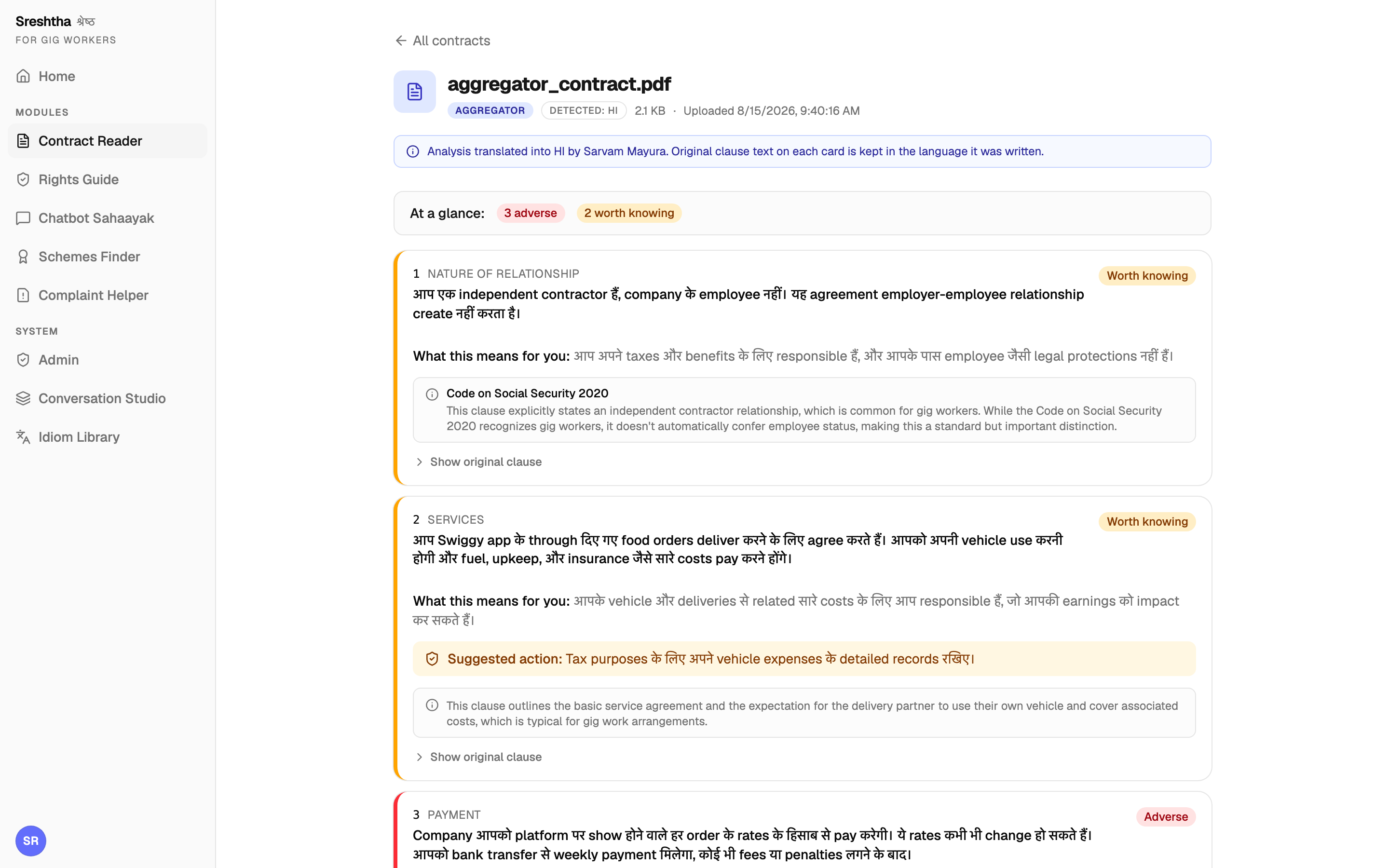
LiveContract Reader. Upload a platform agreement (PDF or phone photo), receive a clause-by-clause breakdown, statute citations, risk tiering, and suggested actions.
-
NextRights Guide. Curated fact cards on wages, injury, dismissal, harassment, insurance, and grievance escalation. Every fact traces back to statute.
-
NextChatbot Sahaayak. Natural-language questions answered from the rights corpus, with the worker's own uploaded documents in scope, citations attached to every response.
-
NextSchemes Finder. A three-question wizard that surfaces every central and state scheme the worker qualifies for, with document checklists and apply-link routing.
-
NextComplaint Helper. Draft a formal complaint in the worker's language, routed to the right authority (state Labour Commissioner, e-Shram grievance cell, POSH internal committee, or India Labourline).
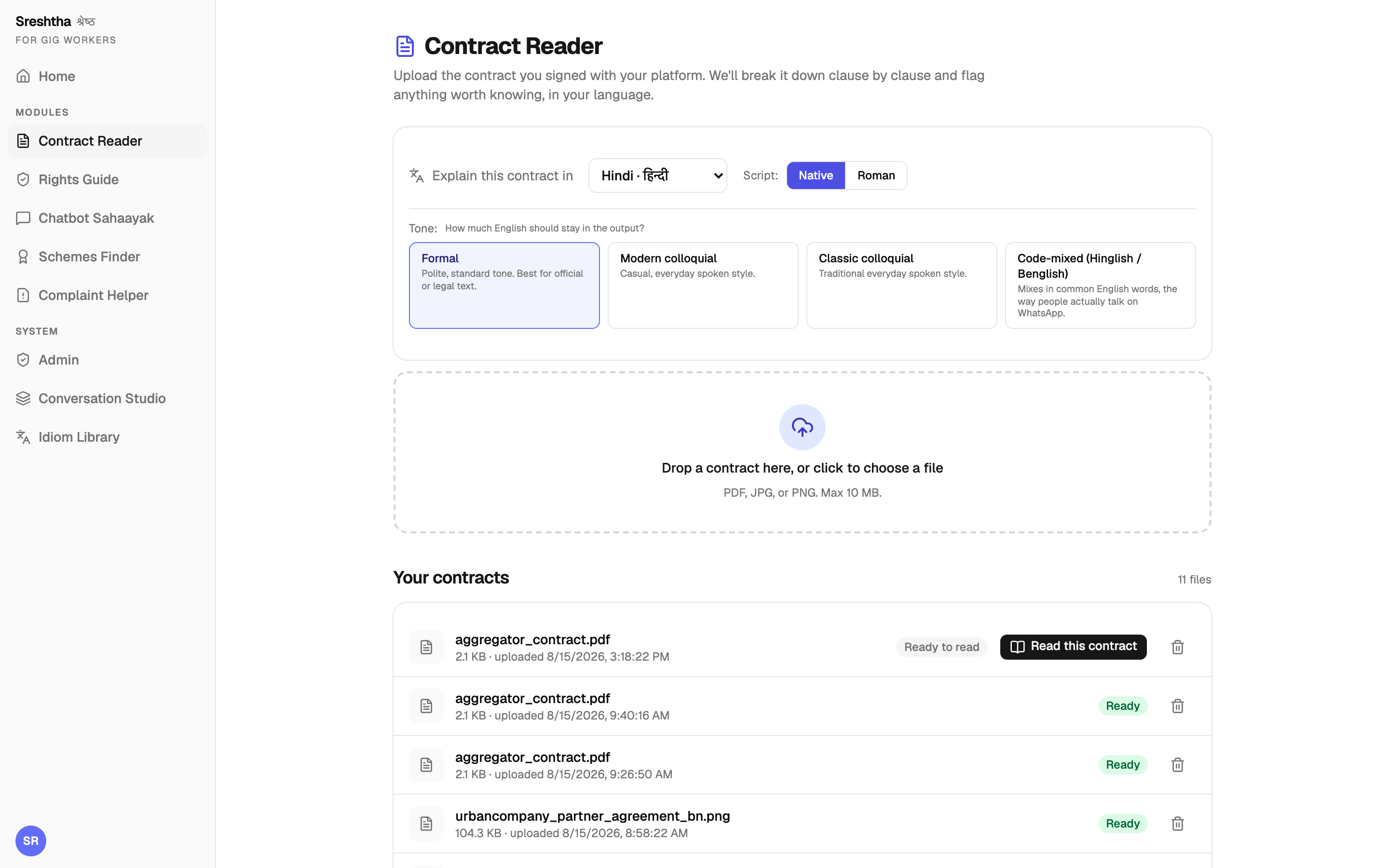
Every module speaks seven Indic languages with four tone modes. A worker who reads Hinglish gets Hinglish. A worker who reads classical Marathi gets classical Marathi. That choice sits on the upload form, not in a settings menu, because the wrong default would lose the audience on first use.
Why now
Three tailwinds arrived within the last two years and none of them existed simultaneously before:
- Regulatory recognition. Sections 113 and 114 of the Code on Social Security 2020 [2] formally category-defined gig workers and created a legal basis for welfare schemes. Karnataka [4] and Rajasthan [3] now operate their own welfare boards.
- Indic-first AI matured. Google Gemini 2.5 Flash handles legal reasoning with a depth general-purpose models did not have two years ago. Sarvam AI's Mayura v1 covers seven Indic languages with fine-grained tone control that Western LLMs do not expose. An application-layer builder can now serve Indic-first users without training models.
- Smartphone reach caught up. Most gig workers already use their platform's app daily. A worker-facing app meets them on infrastructure they already own.
Trajectory
Contract Reader is live. The four remaining modules ship on the shell that already hosts it: shared auth, shared admin surface, shared language and idiom infrastructure. The app itself is the distribution unit; individual modules are the value delivered. Post-app-launch: fine-tuned OCR on the specific document formats Indian gig workers actually get (delivery agreements, welfare board applications, insurance policy statements), per-state complaint routing, and direct scheme application via portal integrations where those exist.
Reason in English. Translate at the edge.
Every reasoning step runs in English on Google Gemini 2.5 Flash, and every translation step runs in the target Indic language on Sarvam Mayura v1. This split is deliberate. It is also the single most consequential design choice in the stack.
General-purpose Western LLMs have the highest density of legal precedent, statutory language, and deterministic formatting in their English weights. Ask Gemini to extract clauses from an Indian labour contract, annotate them against the Code on Social Security 2020, and rewrite them in plain language, and it does the work reliably. Ask the same model to do all of that and render the final output in classical colloquial Marathi, and quality falls off. The failure is quiet, which is the dangerous kind: fluent but subtly wrong.
Sarvam Mayura, purpose-built for Indic translation, does not have general-purpose legal knowledge. Given a finished, statute-annotated English rewrite, it produces high-fidelity Hindi, Bengali, Tamil, Telugu, Kannada, or Marathi output at four register modes. Isolating the two responsibilities across two models means each one only ever does what it is best at.
The three-stage Gemini pipeline
- Stage 1 — Extract. The contract's OCR'd text goes in. Gemini identifies the contract type (aggregator, labour, vendor), extracts every distinct clause, and labels the legal concepts each one invokes. Structured output, strict JSON schema.
- Stage 2 — Annotate. Each clause is cross-referenced against Indian labour law: Code on Social Security 2020 sections, Motor Vehicles Act aggregator amendments, Fairwork India principles, state gig-worker legislation. Every clause exits Stage 2 with a risk tier (adverse, worth knowing, favourable) and a statute reference where one applies.
- Stage 3 — Rewrite. Gemini produces the final worker-facing rendition, still in English: original clause, plain-language explanation, practical implication for the worker, and a suggested next step. This is what Mayura eventually translates.
Each stage is a discrete Gemini call with a strict output schema. Failures do not cascade: a failed Stage 2 falls back to Stage 1-only output, so the worker sees the contract explained even if statute annotation is temporarily unavailable.
Vision runs in-house
Contract images and PDFs go through Sreshtha's own EasyOCR pipeline with per-language readers cached in memory. Worker documents never leave the platform for a vendor's vision API. Two consequences follow. First, the sensitive data (photos of signed employment agreements, IDs, phone numbers) stays inside the perimeter. Second, the path to fine-tuning on India-specific document types (delivery partner agreements, Karnataka Welfare Board forms, PMSBY policy statements) is realistic post-launch, because Sreshtha owns the vision layer.
Gemini Vision is a viable v2 swap if quality on rare scripts proves insufficient. The pipeline is model-agnostic at the OCR layer.
An idiom library for cultural fidelity
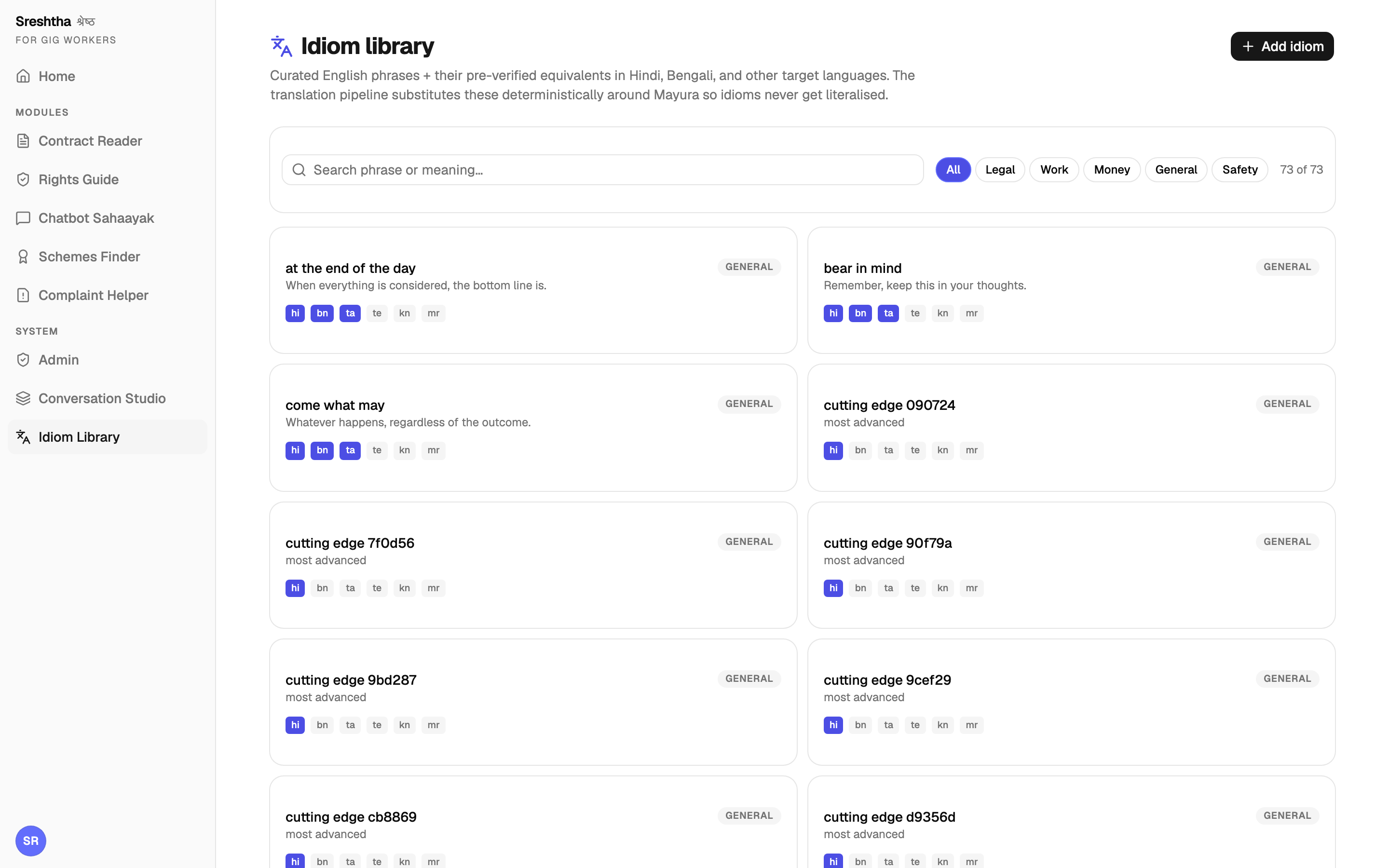
General-purpose translation literalises idioms. The submission's canonical example: "at the end of the day" in a payment reconciliation clause. Baseline models translate it to a Hindi phrase referring to the final hour of a work shift. A worker reads that and assumes reconciliation runs at 11:59 pm every night, rather than understanding the phrase means ultimately or in the final analysis. The grammar is flawless. The legal meaning is destroyed.
Sreshtha detects known idioms with an in-house pattern-matching engine (roughly 200 microseconds per scan, regardless of clause length), swaps them for opaque placeholder tokens before Mayura sees the text, and splices in hand-curated target-language equivalents after Mayura returns. The idiom never touches the general-purpose translator. Expanding the library is a no-code admin action.
Chunked translation for real-world documents
A real delivery-partner agreement runs 90 or more clauses. Naive per-clause translation hit Sarvam's rate limits during benchmarking and turned an 18KB contract into an 11-minute translation job. A worker who has just uploaded a photo of their contract will not wait 11 minutes on a mobile screen.
Sreshtha packs multiple clauses into single Mayura calls, separated by boundary tokens that the model is prompted to preserve in its output. The same document now completes in under a minute, with roughly a tenth of the API calls. This is the difference between an app a worker uses and an app a worker abandons on first upload.
Powered by Google AI
Sreshtha's reasoning core is Google Gemini. Every clause a worker sees explained, every risk tier applied, every statute annotation added has passed through a Gemini call. The following is an inventory of Google technology currently in production, and Google technology on the near-term roadmap.
In production today
| Google tool | Where in Sreshtha |
|---|---|
| Gemini 2.5 Flash |
Contract Reader's three reasoning stages (extract clauses
→ annotate against Indian labour law → rewrite for the
worker). Runs entirely in English by design. Hosted on
Vertex AI, region asia-south1.
|
| Gemini 2.5 Flash‑Lite | Language detection and lighter classification calls where the cost floor matters more than the reasoning ceiling. |
| Vertex AI |
Hosts both Gemini models. Production auth via a service
account (GOOGLE_APPLICATION_CREDENTIALS +
GOOGLE_CLOUD_PROJECT). The
asia-south1 region keeps round-trip latency
low for Indian users.
|
| Google AI Studio |
Alternate auth path (GEMINI_API_KEY) for
local development and solo-builder velocity. Zero
service-account setup during iteration.
|
| google‑genai SDK | The Python client (v1.0+). Supports both Vertex AI and AI Studio auth paths from the same call sites. |
On the near-term roadmap
| Google tool | Purpose |
|---|---|
| Cloud Run | Production deploy of the FastAPI backend and Vite-built frontend. Autoscaling to zero fits the traffic profile of an early-stage worker-facing app. |
| Cloud Storage | Encrypted at-rest storage for worker-uploaded contracts, with lifecycle policies that expire raw uploads after processing. Currently local disk during development. |
| Gemini Vision | A v2 alternative to the in-house EasyOCR pipeline for low-quality contract photos in rare scripts. Vision remains model-agnostic behind an internal interface. |
Why Gemini specifically
Three properties made Gemini the right choice for this product's reasoning core:
- Structured output reliability. All three pipeline stages depend on strict JSON schemas. Gemini 2.5 Flash follows response schemas without the drift that would break downstream deterministic code.
-
Latency profile.
Contract Reader is interactive: a worker uploads and waits.
Gemini 2.5 Flash at Vertex AI's
asia-south1region hits a 90-clause contract's full three-stage pipeline in the low tens of seconds. - Legal-reasoning depth in English. The single most important quality metric for Sreshtha is whether Stage 2's statute annotation is accurate. Gemini's English legal training density is what makes the annotation reliable enough to show to a worker who might act on it.
The chatbot cost trap, and how it is contained
A worker-facing chatbot running at scale on general-purpose LLMs is a compute pit. A single conversational turn costs between ₹3 and ₹8 at list prices when you add up Gemini generation, Mayura translation, vector retrieval, and optional voice. At five million active users, twenty-five percent of them using the chatbot for six turns a month, the annual compute bill approaches ₹230 crore. No consumer app for gig workers survives that.
Sreshtha's Chatbot Sahaayak is engineered to make that number untrue. The architecture is retrieval-first: every query first hits a vector index over the Rights Guide fact cards and the worker's own uploaded contract clauses. If the retrieval score exceeds a hard-coded confidence threshold, the response is composed directly from the matched card plus a citation. No LLM call happens at all. The system only escalates to a full Gemini generation when nothing matches.
In benchmarking, this collapses raw LLM traffic by 60 to 80 percent. The cost of a retrieval-served turn is a fraction of a rupee. Paired with a soft cap on the free tier (ten LLM-generated responses per month, unlimited retrieval-served answers), the fully loaded cost per free-tier user stays under ₹15 per month. The unit economics work not because the model is cheap, but because most questions do not need one.
Humane usage rules
Hard caps have failure modes. A worker in a genuine crisis, drafting a safety complaint, cannot be blocked because they used their ten free turns earlier in the month. The system carries an explicit exemption: any action classified as a safety-critical complaint or grievance draft bypasses the rate cap. The exemption is logged and audited but not gate-kept.
Unit economics at maturity
| Line | ₹ per active worker per year |
|---|---|
| Fully loaded cost | ₹40 – 90 |
| Blended revenue | ₹150 – 400 |
| Notes | Blended revenue pulls from welfare-board contracts, union subscriptions, curated sponsorship placements, and direct-to-worker paid tiers. Customer acquisition cost is engineered close to zero: states and unions handle the distribution. |
Paid tiers, positioned as a graduation path
Direct monetisation from workers exists but is never a barrier to entry. Roughly ninety percent of workers only need occasional help, and their usage is fully subsidised by welfare-board and union contracts. The paid tiers are engineered for the small population of heavy users who actively analyse multiple contracts a month.
-
Pay-per-scan₹49 for an additional contract analysis once the free quota is used up. Discounted credit packs for bulk purchase.
-
Sreshtha Pro₹99 per month. Removes the LLM cap entirely, unlocks offline mode, priority contract processing.
Source
Source repository at github.com/erragro/sreshtha . © 2026 Surajit Chaudhuri. All rights reserved.
References
- NITI Aayog. India's Booming Gig and Platform Economy: Perspectives and Recommendations on the Future of Work. June 2022. Full report (PDF)
- Ministry of Law and Justice, Government of India. The Code on Social Security, 2020 (No. 36 of 2020). Sections 113–114 cover platform-based and gig workers. Gazette (PDF)
- Government of Rajasthan. Rajasthan Platform Based Gig Workers (Registration and Welfare) Act, 2023.
- Government of Karnataka. Karnataka Platform-Based Gig Workers (Social Security and Welfare) Ordinance, 2024.
- Fairwork India. Annual ratings of digital labour platforms in India, scored across five principles: fair pay, fair conditions, fair contracts, fair management, fair representation. fair.work/en/ratings/india/